What it means when you dream about someone dying, or your own death
Last updated: October 2026
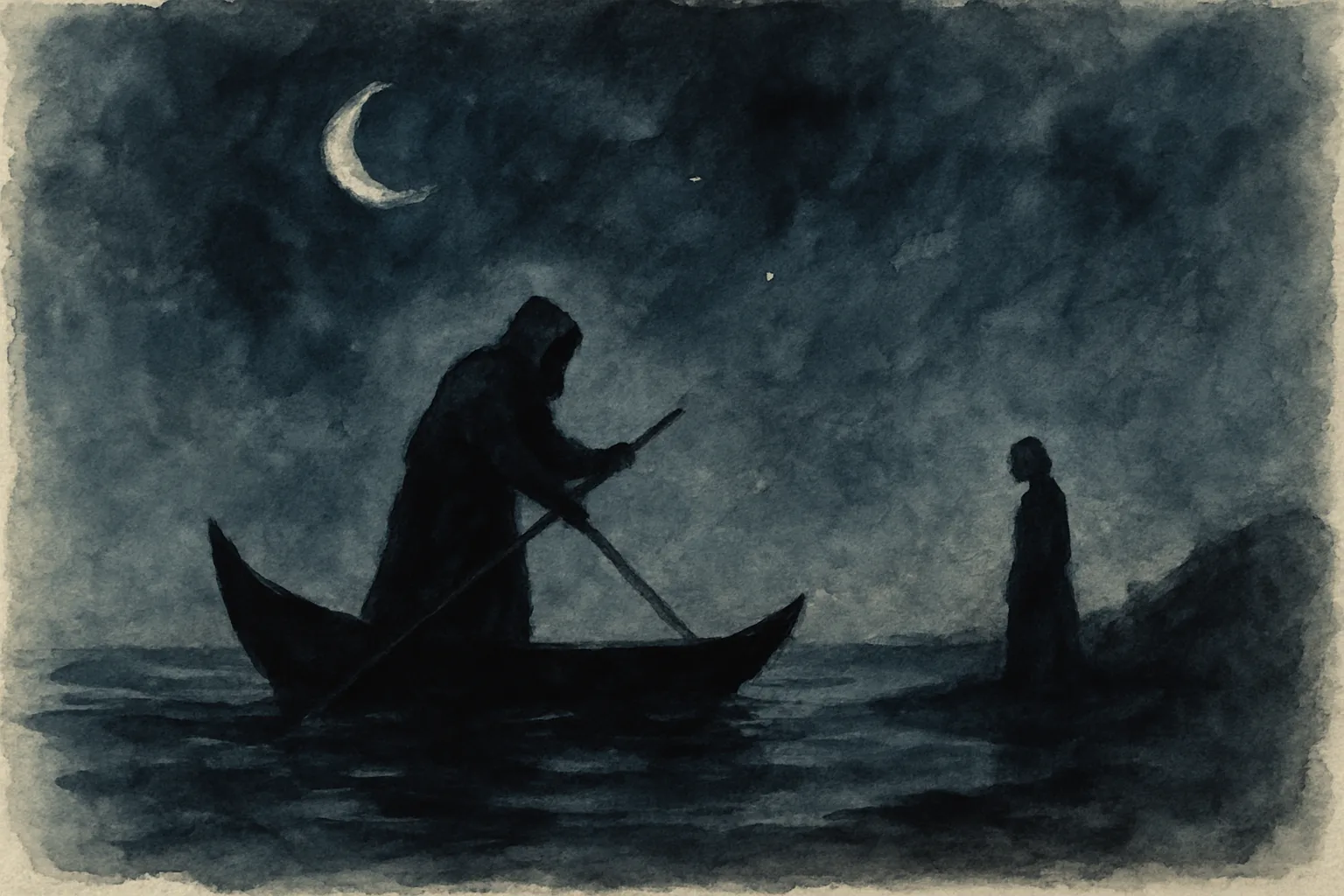
Dreaming about someone dying, or about your own death, is not a prediction. In the Jungian method death in a dream most often pictures an ending inside you: a role, an attitude or a chapter that has run its course, or the weight of a bond. Who died and how you felt decide which reading fits.
Few dreams frighten people as much as a death dream, and few are as often misread. The fear usually comes from taking the image literally, as though the dream were announcing an event. It is not. A death dream is one of the clearest cases of an image that means something other than its surface, and reading it well begins by setting the prophecy question aside. What remains is an image about endings, and it rewards care. The sections below take its facets one at a time.
What does death in dreams mean?
Death in a dream ends one form so that another can take its place. Jung, drawing on the long history of death and rebirth in myth and religion, read many death dreams as images of transformation: an outworn identity or attitude closing, clearing ground for what follows. He also observed that the unconscious often pictures death quite differently from the conscious mind, less as a full stop than as a change of state. The useful question is not "who will die?" but "what in me, or between us, is ending?"
Does dreaming about someone dying mean they will die?
No. It is worth saying plainly: a dream about someone dying is not a forecast, and there is no reliable evidence that such dreams predict real deaths. Jung read the rare dream that seemed to anticipate events as the psyche sensing a change already under way, never as prophecy. A responsible reading treats the dream as a picture of your inner life, not of anyone's future.
Dreaming about your own death
To dream of your own death is disquieting, but it is rarely about the body. One reading is that an identity is ending: a role you have outgrown, or a chapter closing so the next can open. Read the feeling closely. Dread can point toward a change you are resisting. An unexpected calm, even relief, can point toward a part of you that is ready to let an old self go. The dream is not announcing your end. It may be marking a threshold you are already crossing.
Dreaming about a parent dying
Dreaming of a mother or father dying is among the most distressing images the psyche produces, and it does not mean they are in danger. On the personal layer it often tracks a shifting relationship: a parent's authority loosening as you come into your own, or the first sense that the roles are turning, with you now looking after them. On the archetypal layer the parent is also an inner figure, an inherited attitude or a voice you grew up with. What is dying may be a version of that bond, or an old way of being their child.
Dreaming about your child dying
Few dreams are harder to wake from, and it is worth saying gently that this one is common among parents, especially when a child is changing quickly. It does not mean your child is at risk. On the personal layer it often accompanies a stage ending: a teenager pulling away, or a grown child leaving home. Love grieves those changes even as it welcomes them. On the archetypal layer the child can also be a new and vulnerable possibility in the dreamer, something young in you that feels neglected or under threat.
Dreaming about a partner or friend dying
When the person who dies is a partner, a close friend or someone you have lost touch with, the dream often concerns the relationship rather than the person. It can mark a closeness that has quietly changed, or a friendship that ended without being mourned. Sometimes the figure stands for a quality you associate with them, their humour or their nerve, which feels as if it is dying in your own life. Ask what this person carries for you, and whether that has gone quiet lately.
Dreams about someone who has already died
Dreams of the dead are common in grief, and they can be vivid and tender. Sometimes the person appears well, or says something; sometimes they are simply there. One reading is that the psyche is continuing a relationship that death interrupted, or working at what was left unfinished. These dreams deserve to be sat with rather than solved. Whatever you believe about them, they are real events in your inner life, and for many people they are part of how grief slowly changes shape.
Being killed, or killing someone, in a dream
Violent death in a dream can feel shocking, especially when you are the one who kills. Jung's idea of the shadow is useful here: the parts of ourselves we do not recognise as ours. A dream in which you are killed may picture an attitude of yours being overthrown by something you have kept in the dark. A dream in which you kill may picture an attempt to be rid of a quality you dislike, in yourself or projected onto someone else. Neither predicts anything you will do.
Funerals, coffins and graves
Some death dreams show only what follows a death: a funeral, a coffin, a grave. These images tend to concern how an ending is being handled rather than the ending itself. A funeral is a ritual for letting go in company, and a dream funeral can arrive when a change has happened but has not been marked. Notice who attends, whether you are mourner or the one in the coffin, and whether the ceremony feels finished or interrupted. An unfinished burial often points to an ending not yet accepted.
Death and rebirth: the ending that makes room
In the alchemical images Jung studied, the first stage of the work was the nigredo, the blackening: the old substance had to break down before anything new could form. A death dream can belong to this sequence. It may arrive at the start of a change, when only the loss is visible and nothing new has appeared yet. The reading does not promise a rebirth. It suggests the ending may be part of a process rather than the whole of it.
What does the Bible say about dreaming of death?
The Bible gives no rule for interpreting death dreams, but it often uses death as an image of change. In John 12, Jesus says that a grain of wheat must fall into the ground and die before it bears fruit. Paul writes "I die daily." A reader who brings faith to a death dream can hold it in that light. The Jungian reading respects that and adds one question: what, in this dream, is the grain that has to fall?
What dreams should you never ignore?
In the Jungian method the dreams that most deserve attention are those that recur, those that wake you with strong feeling, and what Jung called "big dreams": images that stay vivid for years and seem larger than the dreamer's personal concerns. A death dream may be one of these, or it may pass in a morning. One more kind should never be ignored: nightmares that repeatedly break your sleep, or that replay something traumatic. Those deserve care from a professional as well as reflection, and there is no shame in asking for it.
How to know if God is warning you in a dream?
Scripture does record warning dreams: the magi, "warned of God in a dream," go home another way. Most traditions also teach discernment, weighing a dream over time, with prayer, scripture and people you trust, rather than alone at three in the morning. A psychological reading cannot settle whether God speaks through a dream. Jung treated religious experience as a real fact of the psyche, and the method can help you hear what the dream itself is saying, which may serve that discernment.
A worked dream: the boat from the shore
The dream below is invented for illustration. It shows the method, not anyone's real dream.
"I know I have died, and I am lying in a long wooden boat being pushed out from a beach. My old colleagues are on the sand, waving. I am not frightened. Halfway across I notice I am still holding my work lanyard, and I let it drop into the water. On the far side a light is on in a small house."
The image
The dreamer's own death, met calmly. A boat leaving a shore where colleagues stand. A badge of identity let go. A lit house on the other side.
Personal association
The dreamer, asked what comes to mind, says she has just left a job she held for twenty years. She has been telling everyone it is "only a career change" and is surprised how flat she feels. The lanyard was the first thing she put on each morning.
Amplification
Crossing water by boat is one of the oldest images of death across cultures, from the ferry of Greek myth to the Egyptian barque of the sun. The far shore is the threshold of a new state. Letting a token go into the water is a familiar gesture of release.
Compensation
Her waking attitude minimises the change. The dream gives it the full weight of a death, and also a calm she has not felt awake. It compensates for "only a career change" by showing that a whole identity has ended, and that the ending can be met without terror.
Synthesis
One reading among several: the working self of twenty years has died, and has not been mourned. The colleagues on the shore are its mourners. Dropping the lanyard is her own part in the letting go. The lit house suggests somewhere to arrive, though the dream does not yet show what lives there.
A small ritual
For five minutes, write a short eulogy for the working self: what it gave, what it cost, what she will miss. Then put the lanyard, or something that stands for it, in a drawer she will not open for a month.
Why your death dream means something different from anyone else's
The facets above are amplification: the long history of what death has meant in dreams and stories. They are not your meaning. The same dream of a parent dying reads one way for someone grieving and another for someone leaving home at forty, and only your associations can tell them apart. That is the difference between a symbol and a dictionary entry, and it is why Jungian symbols are personal before they are universal. For the full method behind this reading, see Jungian dream analysis, and for the step-by-step, how to interpret your dream.
Your ending, not the end.
Read last night's dream the way an analyst would: every image named, your associations gathered, one synthesis and a small ritual to carry it into the day. About ninety seconds.
Bring your own dreamNo account needed, and the first reading is free.
Common questions
What does death in dreams mean?
Death in a dream is almost never about a literal death. In the Jungian method it usually pictures an ending inside the dreamer: a role, an attitude or a chapter of life that has run its course. Who dies and how you felt about it shape the reading. It is a symbol with a range of meanings, never a forecast.
What does the Bible say about dreaming of death?
The Bible gives no rule for interpreting death dreams. It does use death as an image of change: the grain of wheat in John 12 that must fall into the ground and die before it bears fruit, and Paul's "I die daily." A reader of faith can hold a death dream in that light, as an ending that makes room, rather than as a sentence.
What dreams should you never ignore?
In the Jungian method, the dreams worth most attention are the ones that recur, the ones that wake you with strong feeling, and what Jung called big dreams, which stay vivid for years. Nightmares that repeatedly break your sleep, or replay something traumatic, deserve care from a professional as well as reflection. A death dream alone is not one to fear.
How to know if God is warning you in a dream?
Scripture does record warning dreams, such as the magi warned in a dream in Matthew 2. Most traditions also teach discernment: weighing a dream over time, with prayer, scripture and people you trust, rather than alone at night. A psychological reading cannot settle whether God speaks through a dream, but it can help you hear what the dream itself is saying.