What it means when you dream about water or drowning
Last updated: October 2026
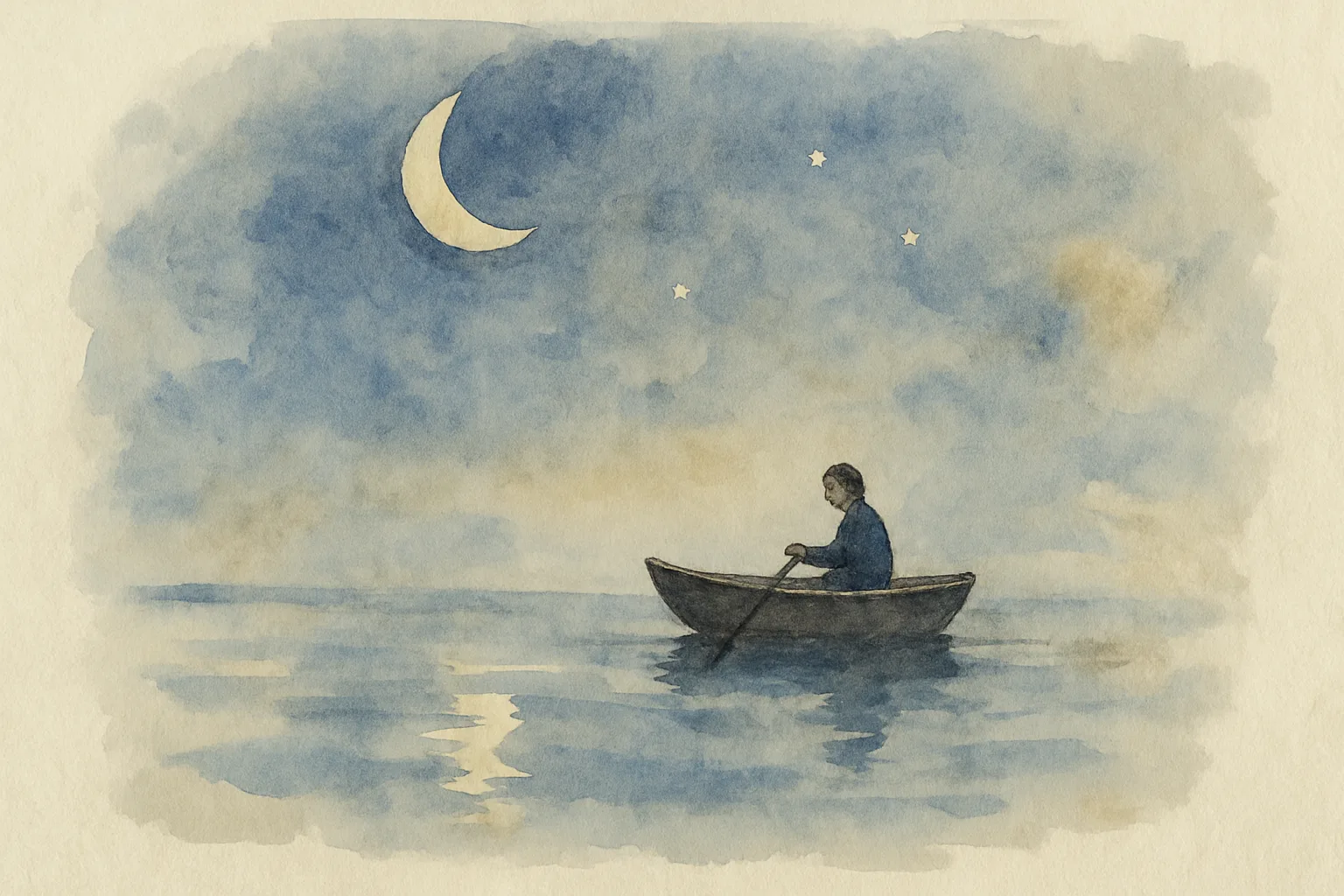
Water in a dream most often pictures the unconscious and the feeling life: the depth below ordinary awareness. Whether it reads as threat, relief or renewal depends on the water's state and what you did in it. Drowning, a flood and a calm lake ask different questions, and your own associations decide which reading fits.
Water is one of the most common settings a dream can choose, and one of the most flattened by lookup tables that turn it into a single word for "emotion". Jung returned to water more often than to almost any other natural image, because it holds opposites: it drowns and it cleanses, it hides and it reflects. The sections below take its facets one at a time. None of them is the answer to your dream. Each is a question worth putting to it.
Is it good to see water in your dream?
Neither, as a rule, and the question is the right place to start because it is the one most people wake with. A water dream is not a sign of fortune or misfortune. It is a picture of your relationship to a depth you do not fully see. The useful distinction is not good against bad but containment against overwhelm. Water held in a glass, a bath or a lake you can swim across tends to mark feeling you can meet. Water rising past your head tends to mark feeling that has outgrown the vessel. Both are meaningful, and neither is a verdict.
Water as the unconscious itself
"Water is the commonest symbol for the unconscious," Jung wrote in The Archetypes and the Collective Unconscious. The surface is what you see; the depth is what you live from without seeing. Read this way, a body of water in a dream is rarely just scenery. It is the dreamer's own depth made visible, and what the water is doing, lying still, rising, breaking or closing over your head, is the dream's comment on how you stand in relation to it. The first question is simple: were you on the water, in it, or watching it from the shore?
Dreams about drowning
Drowning is the water dream most people search for, and the reading usually begins with overwhelm. Something has risen past the line where you can keep your head above it: grief, work, a relationship, a decision deferred too long. In Jung's sense the dream is often a compensation, the unconscious pressing content into view because waking attention has been holding it under. Read the exact motion. Struggling against the water reads differently from a strange calm as you go down, and being pulled under differs from wading out too far yourself. The dream shows your stance, not only the flood.
Tidal waves and tsunamis
A tidal wave concentrates the same theme into one event. Where a slow flood is pressure accumulating, the wave is the moment it arrives, often seen from a distance while you stand unable to move. That distance is part of the image. The dream frequently comes when something large is visibly approaching and has not yet broken: an ending, or a feeling you have kept offshore. Whether you run for higher ground or turn to face it says how you are meeting it, and each is a different reading of the same water.
Clear water and murky water
The state of the water is the single most useful detail. Clear water you can see the bottom of tends to accompany periods of clarity, when you can look into yourself without being dragged under. Murky, dark or muddy water tends to accompany the opposite: something stirred up, a depth you cannot read, a content not yet named. The pairing is not always obvious. Calm water whose depths are black can carry a quiet unease, and rough water you swim in with confidence can carry competence. Read the feeling first, then the surface.
Dreams about water rising in the house
In dreams the house is often read as a picture of the dreamer's own psychic structure, its rooms standing for areas of life. Water coming into the house means the depth is no longer out in the landscape. It is inside, in the bedroom or the stairwell. Note the level. A cellar filling slowly reads differently from water pouring through the ceiling, and a flooded bedroom differs from a flooded office. The question is what feeling has broken its banks into the place you live, and whether you are bailing it out or watching it rise.
Swimming, and breathing underwater
Not every water dream is a struggle. Some people swim strongly in their dreams, or find themselves underwater and able to breathe, with the panic of drowning entirely absent. In the Jungian method this often marks a changed relationship to the unconscious: being able to go down into the depth and stay, without being destroyed by it. It can accompany a season of inner work, when what once threatened to overwhelm has become something you can inhabit. As with every water image, the feeling decides. Wonder points one way; an eerie numbness points another.
The sea, the lake and the river
Different waters carry different shapes. The sea is the widest image of the collective unconscious in Jung's sense: depth without edges, older than any one life. A lake is depth contained, bounded by a shore, often closer to the personal layer. A river moves, and so it tends to attach to time, direction and the question of whether you are carried along or standing on the bank. A pool or a bath is water at human scale. Asking which water your dream chose is often more revealing than asking what water means.
Solutio: when things dissolve
Jung found in alchemy a long series of images for psychological change, and one of its operations was the solutio: placing a hardened substance in water until it dissolves. Some water dreams have this quality. Something solid melts, or a fixed shape loses its edges. The analytic writer Edward Edinger read the solutio as the dissolving of a rigid attitude so that it can take a new form. It can feel like loss of footing, and it often is. It can also be the first stage of a change that could not happen while the old shape held.
Baptism, washing and rebirth
Being immersed and coming up again is one of the oldest pictures of renewal, and it appears in dreams of washing, bathing, being pushed under and surfacing, or walking out of the sea in new clothes. Jung read such images as death and rebirth in symbolic form: an old attitude given up so that something new can begin. Hold it as a door, not a conclusion. Many people who dream of washing feel exposed rather than renewed, and the reading turns on that difference. What were you trying to wash off, and what did you feel when you came up?
What's the rarest dream to have?
The question appears beside water dreams in search results, and the honest answer is that no reliable ranking exists. Surveys of typical dream themes can show which images many people report, but they cannot say which dream is rarest in any meaningful sense. Water is one of the common ones. In the Jungian method the rarity that matters is personal: an image you have never dreamed before, or a recurring one that suddenly changes. A dreamer who has drowned for years and one night swims to the shore has had a rare dream, whatever any survey says.
What does the Bible say about dreaming of water?
The Bible gives no rule for interpreting water dreams, but water runs through it in two directions. There are waters that overwhelm: the flood of Genesis, and the Psalmist's cry that the waters have come in unto the soul (Psalm 69). There are waters that renew: the still waters of Psalm 23, the Jordan where Jesus was baptised, and the living water he offers in John 4. A reader who brings faith to a water dream can hold both. The Jungian reading respects that doubleness and adds one question: did this water threaten you, or restore you?
What is the spiritual meaning of dreaming about water?
Across traditions water has carried origin, cleansing, danger and renewal, often at once. Creation stories begin with waters; purification rites use them; flood myths end worlds with them. The Jungian view does not dismiss those meanings or pick one. It treats them as the image's long history, the amplification that shows how much water has meant to people. The meaning for you is narrower and more useful: what this water, in this dream, was doing at this point in your life.
A worked dream: the water on the stairs
The dream below is invented for illustration. It shows the method, not anyone's real dream.
"I am in the house I grew up in. Clear water is coming up the stairs from the cellar, warm, not frightening. My father calls from upstairs for me to bring towels and stop it. I go down into the water instead, and at the bottom I find I can breathe. There is a door down there I have never seen before."
The image
Water rising inside a childhood house, clear and warm. A parental voice asks for it to be stopped. The dreamer descends, can breathe, and finds an unknown door.
Personal association
Asked what comes to mind, the dreamer says his father prized "keeping things dry", meaning practical and unemotional. He has recently started painting again after fifteen years and has told no one. The cellar was where his old paints were stored.
Amplification
Water as the unconscious, rising into the house of the personality. Descent below ground as the old motif of going down to find what was lost. A hidden door as a threshold into a part of the house, and of the self, not yet known.
Compensation
His waking attitude follows the father's rule: keep it dry, stop it spreading. The dream sets beside it water that is warm and breathable, and a self that chooses to go down rather than fetch towels. It compensates for the caution by showing that the depth is survivable.
Synthesis
One reading among several: a feeling life kept in the cellar, connected to the returning painting, has begun to rise. The inherited instruction is to mop it up. The dream offers a different option, to go down into it and find out where the door leads, and it shows him able to breathe there.
A small ritual
For five minutes, paint or draw the door at the bottom of the stairs, without trying to make it good. Then write one sentence about what might be behind it, and leave the sentence unfinished.
Why your water means something different from anyone else's
The facets above are amplification: the long history of what water has meant. They are not your meaning. The same rising water reads one way for someone overwhelmed at work and another for someone letting a long-held grief come up at last, and only your associations can tell them apart. That is the difference between a symbol and a dictionary entry, and it is why Jungian symbols are personal before they are universal. For the full method behind this reading, see Jungian dream analysis, and for the step-by-step, how to interpret your dream.
Your water, not the water.
Read last night's dream the way an analyst would: every image named, your associations gathered, one synthesis and a small ritual to carry it into the day. About ninety seconds.
Bring your own dreamNo account needed, and the first reading is free.
Common questions
Is it good to see water in your dream?
It is neither good nor bad as a rule. Water in a dream is not an omen. In the Jungian method it usually pictures the unconscious and the feeling life, and the reading depends on the water's state and your stance in it. Clear water you can swim in reads differently from a flood, and both are worth reading.
What does the Bible say about dreaming of water?
The Bible gives no rule for interpreting water dreams, but water runs through it in two directions. There is the flood and the deep waters of the Psalms that come in over the soul, and there are the still waters of Psalm 23, the Jordan and the living water of John 4. A reading can hold both: water that overwhelms and water that renews.
What's the rarest dream to have?
There is no reliable ranking of the rarest dream. Surveys of typical dream themes show which images many people report, not which is rarest in any meaningful sense. Water is one of the common ones. In the Jungian method the rarity that matters is personal: an image you have never dreamed before, or one that suddenly changes after years of repeating.
What is the spiritual meaning of dreaming about water?
Across traditions water has meant origin, cleansing, danger and renewal, often at once. The Jungian view treats those meanings as the image's long history rather than a verdict. The question for your dream is narrower: what this water, in this state, was doing in your life at this point, and how you met it.