What it means when you dream your teeth are falling out
Last updated: October 2026
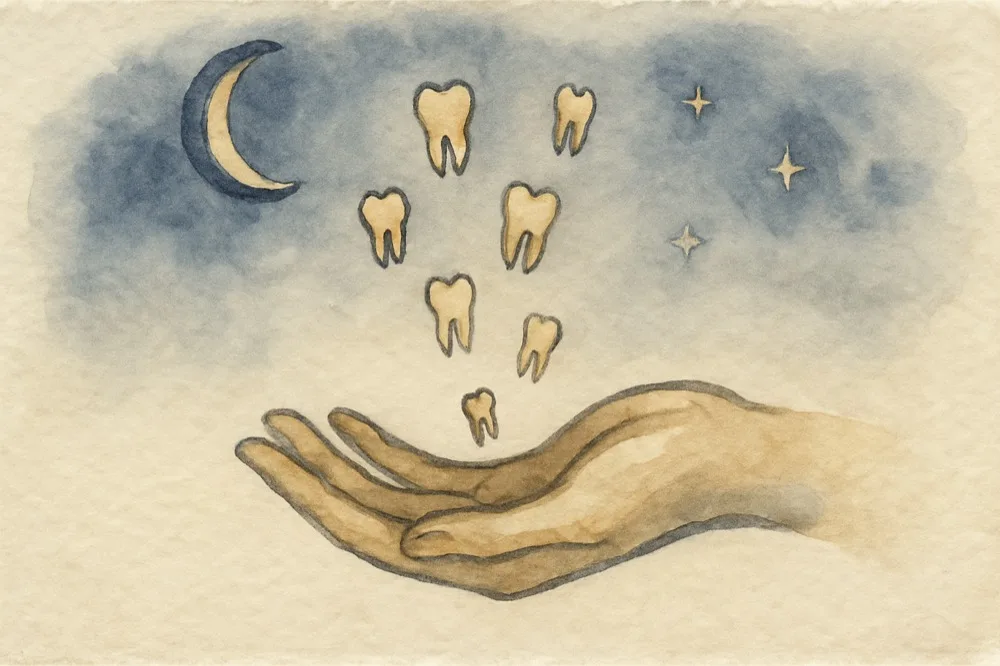
A dream of teeth falling out most often gathers around control, appearance and the power to speak: something you have relied on is coming loose. It is not a dental or health forecast. Whether it reads as loss or as release depends on how you felt in the dream and what is changing in your waking life.
Teeth falling out is among the most searched dream images there is, and among the most flattened by lookup tables that reduce it to "anxiety" or, worse, to a prediction. Teeth carry weight because they do real work: they bite, they hold, and they show every time you speak or smile. The sections below take the image's facets one at a time. None of them is the answer to your dream. Each is a question worth putting to it.
Is teeth falling out in a dream good luck?
Neither good luck nor bad, and the question is the right place to start because it is the one most people wake with. A teeth dream is not a sign of fortune or misfortune. It is a picture of something you rely on coming loose. The useful distinction is not luck against ill luck but dread against relief. Dread tends to mark a loss you are resisting, a grip you are trying to keep. Relief, which people report more often than they expect, tends to mark something outworn finally giving way. Both are meaningful, and neither is a verdict.
What teeth carry: bite, grip and display
In the analytic method you start from what the image actually does before reaching for any general meaning. Teeth bite through things, which links them to assertion and appetite. They hold on, which links them to grip and endurance. And they are on show, which links them to how you appear to others. A teeth dream usually concentrates on one of these more than the others. Asking which function failed in the dream, the bite, the hold or the smile, is often the quickest way into what the dream is about.
Loss of control in a season of change
The most common thread is control. Teeth are fixed, until in the dream they are not. That reversal fits periods when something solid has begun to move: a job ending, a relationship shifting, a decision not yet spoken aloud. In Jung's sense the dream is often a compensation, the psyche registering a change that waking attention has managed to overlook or keep at a distance. The question is not "what will go wrong?" but "what is already moving that I have been treating as fixed?"
Teeth and appearance: when the persona cracks
Jung used the word persona for the social face: the role and manner we present to the world, necessary and never the whole of us. Teeth belong to that face. Dreams in which teeth fall out in public, in a meeting or on a date, often attach to fear of being seen as less competent or less composed than you appear. Read the audience. A dream in which no one notices points one way; one in which everyone stares points another. Both concern the gap between how you appear and how you feel.
Dreams about teeth crumbling or rotting
The exact image matters. Crumbling teeth carry a slow-motion quality, erosion rather than a break, and often attach to a situation degrading gradually or a self-image you feel wearing down. Rotting teeth add something the dreamer may feel is shameful or neglected. A single tooth coming out cleanly reads differently from a whole mouth disintegrating. Read the affect that comes with it. Disgust and calm acceptance turn the same image in different directions.
Spitting teeth out, or holding them in your hand
Whether you spit the teeth out or try to hold them changes the reading again. Spitting them out can carry disgust or a wish to be rid of something. Cupping them in your hand, unable to put them back, tends to carry helplessness and the wish to repair. Some people dream of pushing teeth back into the gum and feeling them loosen again. What you do with the teeth is the dream showing your stance toward the change, not only the change itself.
Losing your bite: teeth and the words you cannot say
Teeth shape speech, and a mouth losing its teeth can be a mouth that cannot get the words out. This reading often fits dreams that arrive before a difficult conversation, or during a period of swallowing anger to keep the peace. English has the idiom ready: a rule or a person "without teeth" has no force. If the dream came in a week when you said yes and meant no, the image may be reporting assertion you have given up, and asking whether you still want it back.
Milk teeth: the old form loosening
Every child loses teeth, and every child's lost teeth are replaced. That near-universal experience sits under adult teeth dreams. Many cultures mark it with small rites: the tooth under the pillow, the tooth thrown onto a roof. Amplified this way, a teeth dream can be a threshold image, the old form loosening before a new one comes through. It is worth asking whether the dream felt like losing something irreplaceable, or like a change you are, in some part of yourself, ready for.
Teeth, ageing and the passing of time
Teeth also mark time. They are one of the places the body shows its years, and teeth dreams sometimes arrive at birthdays, after a parent ages visibly, or when a person first feels older than they think of themselves. On the symbolic layer this can be a dream about mortality and change rather than the body itself. The dream does not tell you anything about the state of your mouth. It may be telling you how you feel about getting older.
Is a teeth dream a health warning?
No. A teeth dream is not a dental or health forecast, and there is no reliable evidence that it predicts a medical problem. Coniunctio makes no medical claims. Grinding your teeth in sleep is real and can be felt on waking, but that is a physical sensation, not a symbolic message. If something physical worries you, see a dentist or a doctor; that question belongs to them, not to a dream. Read symbolically, the image points far more often to control and self-image than to your molars.
Jung and Freud on teeth dreams
Freud gave dreams with a dental stimulus a section of The Interpretation of Dreams and read them largely in a sexual register. It is a narrow lens, and a modern reader is not obliged to accept it. The Jungian approach is wider. The tooth is a genuine symbol, amplified by its parallels in folklore and the childhood rites around lost teeth, while staying anchored to what this image means to this dreamer. The point is not to choose Freud or Jung as a verdict, but to let the symbol keep its range.
What is the biblical meaning of losing teeth in a dream?
The Bible gives no rule for interpreting teeth dreams, but its teeth images point in two directions. Teeth stand for strength and judgement: "a tooth for a tooth" in Exodus, and the broken teeth of the wicked in the Psalms. They also stand for frailty: Ecclesiastes 12 pictures old age as a house where "the grinders cease because they are few." A reader who brings faith to a teeth dream can hold both. The Jungian reading respects that doubleness and adds one question: does this loss feel like power taken away, or like time passing?
What does losing a tooth mean spiritually?
Across cultures a lost tooth has meant the end of childhood, ageing, loss and, in some folk traditions, ill news for the family. The last of these frightens people most, and it is folklore, not a forecast. The Jungian view does not dismiss those meanings or pick one. It treats them as the image's long history, the amplification that shows how much teeth have meant to people. The meaning for you is narrower and more useful: what this tooth, in this dream, was doing at this point in your life.
A worked dream: the tooth in the meeting
The dream below is invented for illustration. It shows the method, not anyone's real dream.
"I am giving a presentation at work, but the room is my old school hall. A front tooth comes loose while I speak and I keep pressing it back with my tongue. Then it falls into my hand and it is a milk tooth, tiny and white. Nobody in the audience notices. I feel relieved and ashamed at the same time."
The image
A front tooth loosening during a public performance in a room that is both work and school. It turns out to be a milk tooth. No one sees. Two feelings arrive together.
Personal association
The dreamer, asked what comes to mind, says she was the "good student" at school and is now up for a promotion she is not sure she wants. Pressing the tooth back reminds her of how she keeps "smoothing things over" in meetings.
Amplification
The milk tooth is the childhood form that must loosen before the adult one comes through. The school hall is the place of being assessed. Teeth on show belong to the persona, the face presented to others.
Compensation
Her waking attitude is to hold the performance together at any cost. The dream sets beside it a tooth that will not stay in, and an audience that does not care. It compensates for the effort by showing that what she is guarding is small, and already outgrown.
Synthesis
One reading among several: the role of the good student, which once fitted, has become a milk tooth. She keeps pressing it back. The relief suggests part of her is ready to let it go; the shame suggests another part still measures herself by it. The promotion may be less the question than the role she would bring to it.
A small ritual
For five minutes, write what she would say in the next meeting if she were not trying to be the good student. Then choose one sentence from it to say aloud, this week, in a real room.
Why your teeth dream means something different from anyone else's
The facets above are amplification: the long history of what teeth have meant. They are not your meaning. The same crumbling tooth reads one way for someone dreading a performance review and another for someone quietly leaving a marriage, and only your associations can tell them apart. That is the difference between a symbol and a dictionary entry, and it is why Jungian symbols are personal before they are universal. For the full method behind this reading, see Jungian dream analysis, and for the step-by-step, how to interpret your dream.
Your teeth, not the teeth.
Read last night's dream the way an analyst would: every image named, your associations gathered, one synthesis and a small ritual to carry it into the day. About ninety seconds.
Bring your own dreamNo account needed, and the first reading is free.
Common questions
Is teeth falling out in a dream good luck?
Neither good luck nor bad. A teeth dream is not an omen, and it is not a dental or health forecast. In the Jungian method the image usually gathers around control, appearance and the power to speak, and the feeling in the dream decides which of those fits. Dread and relief point in different directions; both are worth reading.
What is the biblical meaning of losing teeth in a dream?
The Bible gives no rule for teeth dreams. Its teeth images point two ways: strength and judgement, as in "a tooth for a tooth" or the broken teeth of the wicked in the Psalms, and the frailty of age in Ecclesiastes 12, where the grinders cease because they are few. A reader of faith can hold both: lost power and the passing of time.
What does losing a tooth mean spiritually?
Across cultures a lost tooth has marked the end of childhood, ageing, loss and, in some folk traditions, ill news. The Jungian view treats those meanings as the image's history, not as a forecast. The question for your dream is narrower: what in your life is loosening now, and whether you are holding on to it or ready to let it go.
What does the Bible say about teeth falling out?
The Bible does not mention teeth falling out in dreams. Teeth appear as strength, as judgement and as an image of age: Ecclesiastes 12 pictures old age as a house where the grinders cease. Jeremiah's sour grapes that set the children's teeth on edge add inherited consequence. None of these is a rule for reading a dream, but each can inform one.