Why do I keep dreaming my teeth are falling out?
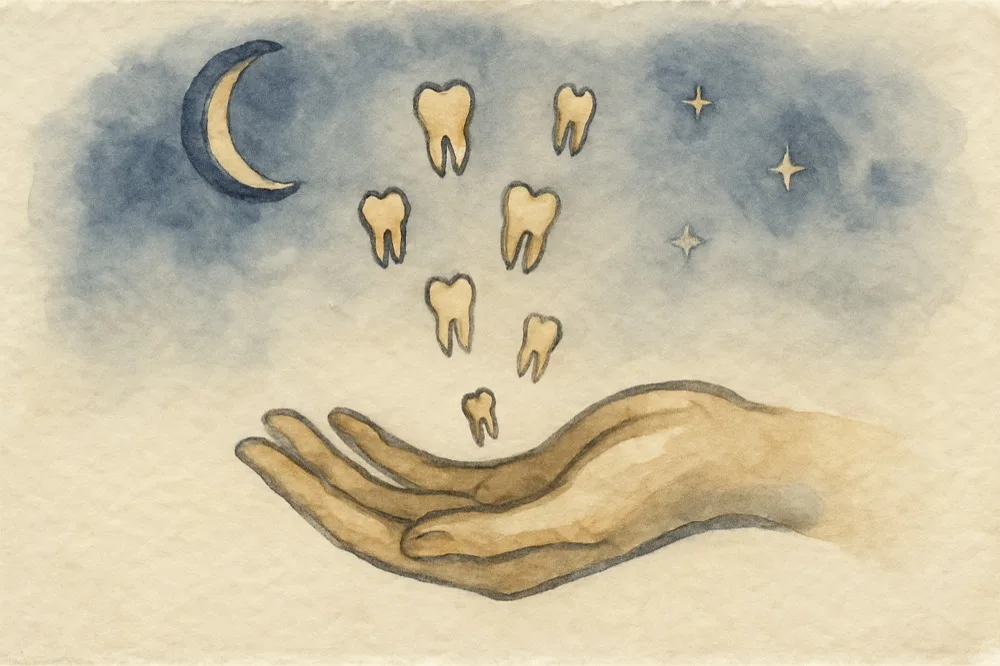
Few dreams return as faithfully as this one. The tooth loosens, then another, and you are left holding them, or spitting them into a sink while someone watches. Once is unsettling. Coming back for the fifth or fiftieth time, it starts to feel like a verdict. It is better understood as a question the psyche keeps asking because it has not yet had an answer.
Why does the same teeth dream keep coming back?
Jung's working assumption was that dreams compensate. They set beside your conscious attitude what that attitude leaves out. If you are telling yourself that everything is in hand, a dream of teeth slipping out of your mouth is a blunt counter-statement: something is not in hand, and part of you knows it.
A single dream can make that point and be done. A recurring one suggests the point has not landed. The psyche repeats an image much as a person repeats a sentence to someone who keeps nodding without listening. This is why the dream often stops, or changes, once the waking situation it refers to is faced. Teeth dreams are among the most common of all recurring dreams, and the same logic applies across them.
What teeth carry in a dream that keeps returning
Teeth are how we bite, grip, chew through and present ourselves. Losing them pictures a loss of one of those capacities: assertiveness, the ability to hold on to something, the confidence of a face shown to others. The full range of these images is set out in our main guide to the teeth falling out dream.
In a recurring dream it helps to ask which capacity is most at stake for you. Someone who has stopped arguing for themselves at work may dream of soft, useless teeth. Someone anxious about ageing may dream of teeth that are simply gone, with no drama at all.
When does it come back? Tracking the timing
The most useful thing you can do with a recurring dream is date it. Write down each occurrence and a line about the day before. Over a few weeks a pattern tends to appear: the dream arrives before a performance review, after a visit to a parent, in the week a decision is due. The trigger is rarely mysterious once it is written down.
Note the gaps too. If the dream vanished for a year and has now returned, ask what was different in that year. A quiet stretch can show what kind of life the psyche found bearable.
What details change the meaning
Small differences between versions matter more than the shared core. Teeth that crumble like chalk point toward something wearing away slowly. One loose tooth you keep testing with your tongue suggests a single worry you cannot leave alone. Teeth falling out in public, at a dinner or a meeting, put the emphasis on being seen. Teeth in your hand, intact, can be gentler: something has come loose, but it is still yours to look at.
Pay attention to pain and blood. Many people notice there is none, only alarm. A painless loss can suggest that the change is already under way and the distress is about meaning, not injury.
Nightmares about teeth falling out
For some people this is not a strange dream but a nightmare: choking on teeth, a mouth filling with fragments, waking with a racing heart. The intensity is part of the message. A dream that frightens you is usually pointing at something you are working hard not to feel.
The fear does not mean the dream is predicting anything. It means the image has been given enough force to wake you. If the nightmare version has become frequent, it is worth turning to the guidance below on when to talk to someone.
The tooth in the envelope
The dream below is invented for illustration. It shows the method, not anyone's real dream.
“I am at my desk and a front tooth comes out when I bite a pen. Nobody notices. I put it in an envelope and keep working. Then another goes. By the end I have a whole envelope of teeth and I still haven't said anything. I wake before the meeting starts.”
Symbols
Front teeth, the ones others see. A pen bitten in silence. An envelope used to hide what is lost. A meeting that never quite begins.
Teeth and speech belong together: we bare them, we bite back words. An envelope is a thing for sealed messages, here holding what has been lost without comment.
Analysis
The dreamer has had this dream, in versions, for three months. Asked about the day before its first appearance, she remembers being passed over for a project and saying nothing. She describes herself as easy-going at work and says the decision was fair.
Her conscious attitude is acceptance. The dream sets beside it a quiet, accumulating loss of bite, filed away so neatly that no one sees it. The repetition matches the repetition of her silence.
One interpretation among several: the dream returns because she keeps sealing the envelope. It is not telling her to fight. It asks whether there is one thing she could say aloud.
Ritual
Write the sentence you did not say in that meeting on a card. Say it aloud once to yourself, then decide whether it needs another listener.
What to do when the dream returns
Each time it comes back, write it down before you check your phone, including whatever changed from last time. Then ask one question of the waking day: where am I losing grip, or not saying what I mean? Keep the answer short and specific.
Some people find it useful to return to the dream deliberately, in imagination, and stay with the moment before the teeth fall. Jung called this kind of engagement active imagination. You are not trying to rewrite the dream, only to meet it while awake. Our guide on how to stop recurring dreams sets out more of this approach.
When to talk to someone
If teeth nightmares are breaking your sleep several nights a week, or arrive alongside panic or low mood that does not lift, speak to your doctor or a therapist. If you wake with an aching jaw or sore teeth, mention it to a dentist; that is a separate question from what the dream means. Working with a dream can sit beside that care. It should not replace it.
Common questions
Why do I keep dreaming my teeth are falling out?
Usually because a waking pressure has not been addressed: a fear of losing control, of how you appear, or of something you cannot say. A recurring dream repeats an image until its point is taken up. Writing down when it returns often shows what that pressure is.
What do nightmares about teeth falling out mean?
The same themes as the ordinary dream, held with more force. A nightmare usually points at a feeling that is being pushed away hard enough that the dream has to wake you. It is not a prediction.
Is a recurring teeth dream a bad sign?
No. Repetition is not a warning of misfortune. It is a sign that something in you is asking for attention, which is useful information.
Will the dream ever stop?
Recurring dreams often change or fade once the situation they picture is faced in waking life. Noticing what shifts between versions is a good way to see that change happening.
Written by the Coniunctio editorial team and reviewed against our editorial standards. Coniunctio offers reflection, not diagnosis or prediction. If a dream is tied to distress, please speak to a professional.
Related guides
What is Coniunctio?
A dream can stay with you all day and still make no sense. Coniunctio analyses it in Jung's method, symbol by symbol, so you can see what it is working on and what to do with it.
- A Jungian analysis of your dream, symbol by symbol
- A ritual to work with it: three offered, you choose one
- Follow-up questions and notes on every analysis
- A dream archive that grows as you feed it
“The dream is a little hidden door in the innermost and most secret recesses of the soul, opening into that cosmic night which was psyche long before there was any ego-consciousness.”