What it means when you dream about falling, read the Jungian way
Last updated: October 2026
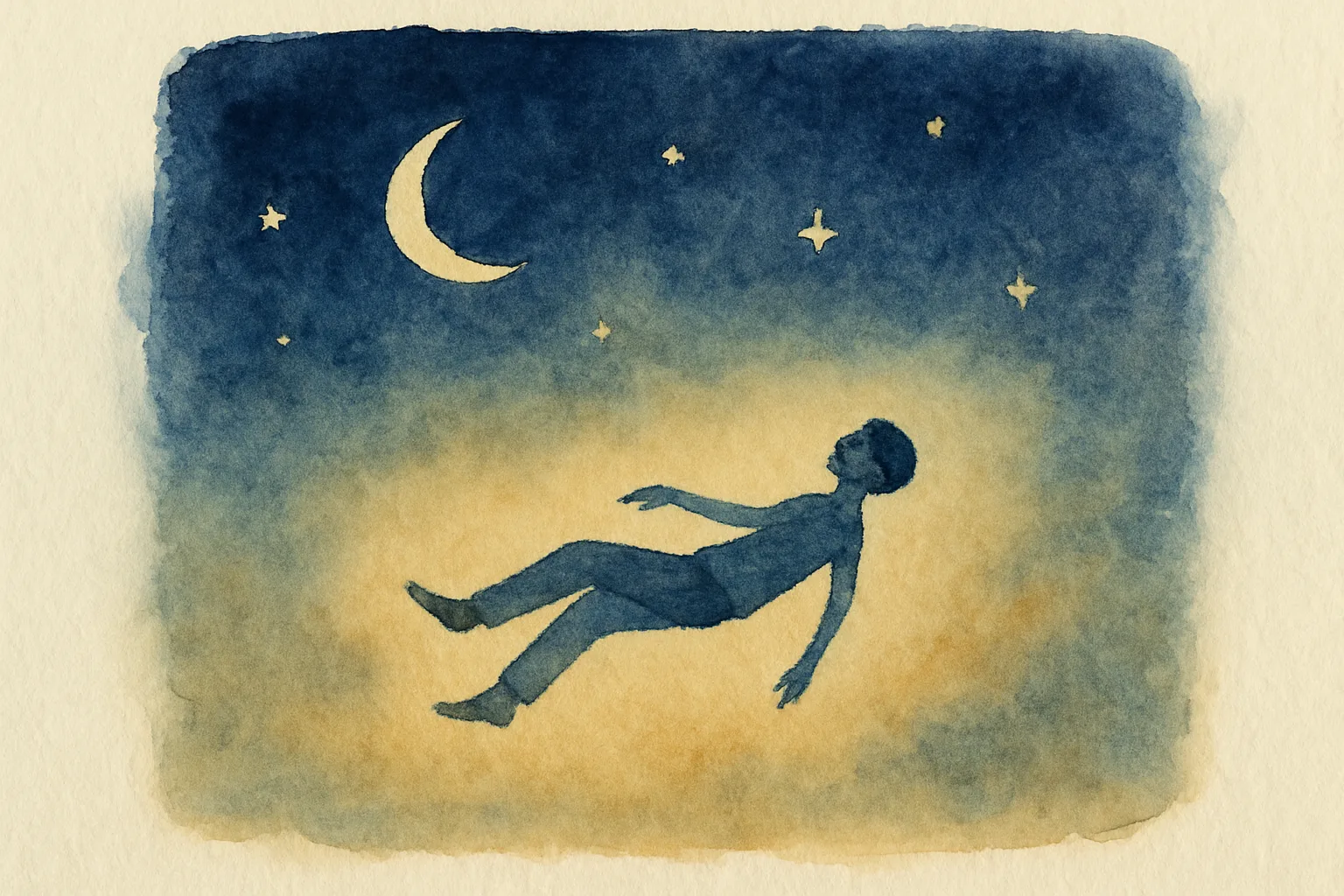
A dream of falling most often pictures the loss of something you were standing on: a role, a certainty, a relationship, a sense of control. In the Jungian method it is not an omen and never a forecast of harm. Whether it reads as collapse, correction or release depends on where you fell from and how the fall felt.
Falling is among the dreams people report most often, which is exactly why a one-line meaning fails it. An image shared by so many different lives cannot carry a single answer. What it can carry is a handful of recurring directions, and a careful reading tests each against your own associations and the feeling of the dream. The sections below take the facets of the fall one at a time. None of them is the answer to your dream. Each is a question worth putting to it.
Why do I dream of falling then wake up?
Start by separating two things that often arrive together. The first is physical. As the body slips into sleep, a sudden involuntary twitch of the muscles is common; it is known as a hypnic jerk, and many people feel it as a lurch or a missed step, sometimes with a flash of falling attached. That jolt is the body settling, not a message. The second is the dream itself: a fall with a setting, a height and a feeling, which you move through before waking. The jolt belongs to physiology. The dream belongs to the psyche, and it is the dream that a reading works with.
What triggers falling dreams?
No single cause produces them, but falling dreams tend to cluster around certain seasons of life. A new job, a move, a relationship that has started to feel uncertain, an exam or a public role you fear failing at: each of these puts something underfoot in question. Stress and broken sleep may also make vivid dreams more likely. The Jungian question is narrower and more useful than "what caused it". It asks what, in your waking life, has recently started to feel less solid, and whether you have admitted that to yourself yet.
Losing the ground: falling and loss of control
The ground is the thing we trust without thinking. A fall removes it, and the dreamer is suddenly subject to a force larger than will. That is why the commonest reading of the image is loss of control. It often appears when something you had arranged carefully has begun to move on its own: a plan, a body, a family situation, a job that is changing around you. The dream does not say the collapse is coming. It shows how the situation already feels from the inside, which is information the composed waking mind may be keeping at a distance.
Falling from a building, a cliff or a height
Where you fall from colours the reading. A building is a made thing, and a fall from a roof, a balcony or a tower often attaches to something you have built deliberately: a career, a reputation, a carefully assembled self. A cliff is a natural edge, the place where known ground simply ends, and a fall from it can point to a threshold you did not choose and cannot control. Stairs, ladders and lifts carry their own associations of gradual climbing. Note the structure, then ask what in your life it most resembles.
Brought down to earth: the fall and inflation
Jung read many dreams as compensation: the psyche showing consciousness what a one-sided attitude leaves out. A falling dream can work exactly this way. When the waking position has climbed too high, into what Jung called inflation, an over-identification with a role, an achievement or an ideal image of oneself, the dream may bring it down. Read this way the fall is not punishment but correction, a return to the level you actually stand on. It is a reading to hold carefully, because it can sting, and because it is only one option among several.
Falling without fear: letting go
The feeling of the fall changes almost everything. Falling in panic and falling in calm are, for the purposes of a reading, nearly different dreams. Panic tends toward the loss-of-control reading: the ground taken away against your will. Calm, or even a strange pleasure in the drop, can point the other way, toward a part of you ready to release its grip on a certainty or an old form of control that has become tiring to maintain. Some dreamers describe the fall turning into floating. That shift is worth recording exactly, because it suggests the psyche is trying out a different stance.
The endless fall: dropping into darkness
Some falls have no floor. The dreamer drops through darkness, a shaft or empty space, and the fall simply continues. Jungian writers connect this image to the descent: the old motif of going down into the underworld, which Jung discussed under the Greek name nekyia. In myth the descent is frightening and necessary, the way the hero reaches what cannot be found on the surface. An endless fall can mark a period of depression or disorientation, or a turn inward that has not yet found its bearings. If low mood has lasted for weeks, that deserves real support, not only a reading.
Being pushed, or watching someone else fall
A push changes the question from loss to agency. If someone pushed you, note who. A known person can point to a relationship in which you feel undermined or hurried toward an edge; a faceless figure may be a part of you that wants a change faster than you are willing to make it. Watching another person fall is different again. A child falling can carry a parent's ordinary fear, or a younger part of the dreamer that seems unprotected. Read the figure first as an outer person, then as an aspect of yourself.
Tripping, slipping and stumbling
Not every fall is from a height. Many falling dreams are small: missing a step on the stairs, slipping on ice, tripping in front of colleagues. These tend to concern footing rather than collapse, and often carry an edge of embarrassment. They can attach to a fear of making a visible mistake, or a sense that you are moving faster than your ground allows. The setting matters here. A stumble at work, in a family home or on a street you grew up on points to a different area of life in each case.
Hitting the ground, or waking just before
There is an old claim that if you hit the ground in a dream you die in your sleep. It is a myth: plenty of people dream that they land and wake up perfectly well. Most falling dreams do end before impact, and that interruption is itself worth reading. Waking at the last moment can reflect how hard it is to stay with what the fall is showing. When dreamers do land, the landing varies: a crash, a soft lawn, water, sometimes an unexpected bounce. How you landed is often the most interesting part of the dream.
What dreams should you not ignore?
From the Jungian view the dreams that most deserve attention are the ones that return, the ones that carry strong feeling and the ones that stay with you for days. A falling dream that recurs is the psyche repeating a point it does not yet feel received, and the repetition often changes slightly as your waking attitude changes. Tracking those changes across months is one of the most useful things a dream journal can do. Dreams that leave you frightened to sleep, or that disturb your rest night after night, are worth raising with a doctor or therapist.
Can dreams be a warning from God?
Many faith traditions hold that God can speak through dreams. The Bible contains several such accounts, from Joseph in Genesis to the dreams in the gospel of Matthew. The Jungian method does not settle that question for anyone, and it does not mock it. Jung took religious experience seriously as a fact of the psyche. What the method declines to do is read a falling dream as a forecast. It treats the fall as a picture of your present situation. A believer can hold both, and bring the dream to prayer and to their own tradition for discernment.
A worked dream: the glass floor in the office
The dream below is invented for illustration. It shows the method, not anyone's real dream.
"I am on the top floor of the building where I work, but the floor is glass. Everyone else walks across it normally. I am carrying a stack of folders and I can see the street far below. The glass cracks under me and I fall, very slowly, past all the floors. I am not as frightened as I expect to be. I land in the small park where I used to eat lunch when I first started the job."
The image
A high floor that only the dreamer can see through. Folders carried at the top. A slow fall past every level, more calm than terror, ending in a modest green place from earlier days.
Personal association
The dreamer was recently promoted to lead a team. The folders remind him of the work he now takes home every night. The park is where he used to sit alone and, in his words, "actually liked the job."
Amplification
The tower and the fall from height are old images of over-reaching and its correction. Glass is transparency: what supports you is also what shows the drop. The return to a garden carries the ancient motif of a simpler, earlier ground.
Compensation
His waking attitude is that the promotion is going well and must not be questioned. The dream sets beside it a floor that others trust and he cannot, and a fall that is oddly bearable. It compensates for his insistence on height by showing that he can survive coming down.
Synthesis
One reading among several: the new role has lifted him above the ground where his interest in the work lived, and part of him already sees through the floor. The dream does not tell him to resign. It suggests that recovering what he valued at the beginning may matter more than holding the height.
A small ritual
For five minutes, write down what he liked about the job in its first month. Then take one lunch this week in that park, without the folders.
Why your fall means something different from anyone else's
The facets above are amplification: the long record of what falling has meant to people. They are not your meaning. The same slow fall reads one way for someone who has climbed too high and another for someone finally willing to let go, and only your associations can tell them apart. That is the difference between a symbol and a dictionary entry, and it is why Jungian symbols are personal before they are universal. For the full method behind this reading, see Jungian dream analysis, and for the step-by-step, how to interpret your dream.
Your fall, not the fall.
Read last night's dream the way an analyst would: every image named, your associations gathered, one synthesis and a small ritual to carry it into the day. About ninety seconds.
Bring your own dreamNo account needed, and the first reading is free.
Common questions
Why do I dream of falling then wake up?
The jolt is usually physical. As the body drifts into sleep, a sudden muscle twitch called a hypnic jerk is common, and the mind can wrap a brief falling image around it. That lurch is the body's business. A longer falling dream with a setting and a feeling is different material, and that is the part a Jungian reading works with.
What dreams should you not ignore?
From the Jungian view, the dreams to take seriously are the ones that return, the ones that carry strong feeling, and the ones that stay with you for days. A recurring fall is the psyche repeating a point it has not yet seen received. Dreams that disturb your sleep night after night are also worth raising with a professional.
Can dreams be a warning from God?
Many faith traditions hold that God can speak through dreams, and the Bible contains several such accounts. The Jungian method does not settle that question for anyone. It reads a falling dream as a picture of your present situation, not a forecast. A believer can hold both, and bring the dream to prayer and to their own tradition for discernment.
What triggers falling dreams?
Falling dreams tend to gather around periods of strain: a change of job or home, a role you fear slipping from, a support that has started to feel unreliable. Poor sleep and stress may make vivid dreams more likely. The trigger in your life is best found by asking what has recently started to feel less solid underfoot.