Why you keep dreaming someone is chasing you, read the Jungian way
Last updated: October 2026
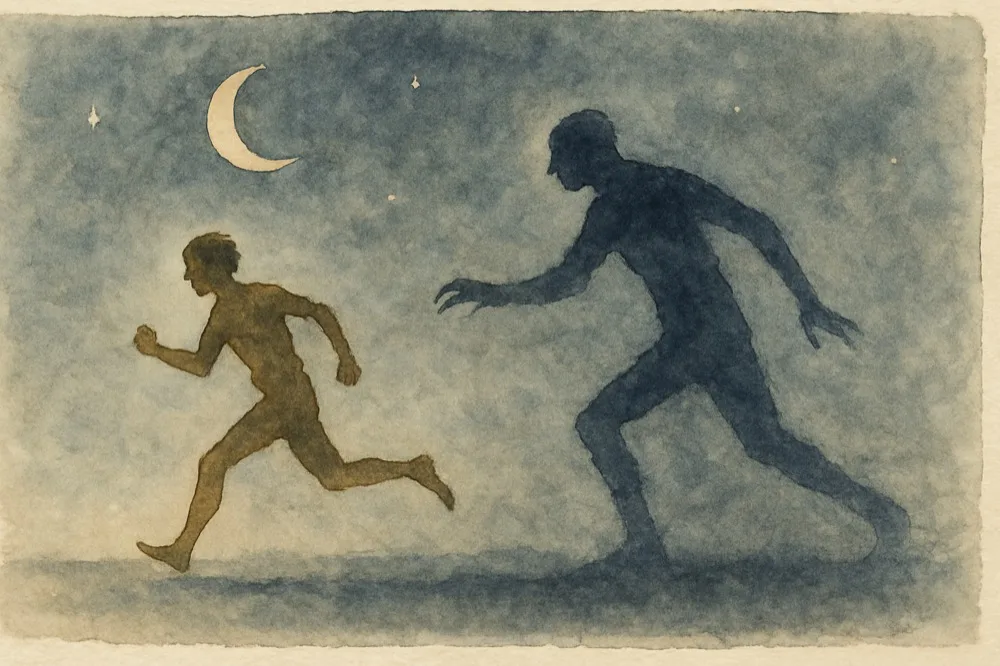
A dream of being chased most often stages your relationship with something you are keeping at a distance in waking life. In the Jungian method the pursuer is frequently read as a part of yourself that has been pushed away, the shadow, though that is one option, not a verdict. Who chased you, and how you felt while running, decide which reading fits.
Few dreams are as physical as the chase: the pounding heart, the narrowing streets, the certainty that something is gaining. It is also one of the most common dreams there is, reported across cultures and age groups, and often returning for years. That universality is the first clue. An image this widespread cannot mean one thing, so the work is to read the particulars of your own chase. The sections below take its facets one at a time. None of them is the answer to your dream. Each is a question worth putting to it.
What does it mean in a dream when someone is chasing you?
Start with the structure before the meaning. A chase has moving parts: you, the pursuer, and the distance between you that the dream keeps trying to close. In the analytic method each carries something. The pursuer is usually what you are avoiding, whether a person, a feeling, a decision or a part of yourself. The running is your present stance toward it. The distance is how far you have managed to keep it. A chase dream rarely says what the thing is outright. It shows how hard you are working not to find out.
The shadow: what pursues you may be what you pushed away
The reading the Jungian method reaches for most often is this one. Jung called the disowned parts of the self the shadow: traits, drives and feelings that do not fit the image we hold of ourselves, and so get exiled from awareness. Exiled, they do not disappear. They follow. A chase dream can be the shadow catching up, insisting on being met. The shadow is not only dark in the moral sense. It can hold anger, ambition, sexuality or plain neediness, and sometimes gifts we were taught to hide. The pursuer may be carrying something you need.
An unknown pursuer: the chaser with no face
Many dreamers never see who is chasing them. They hear footsteps, feel a presence, know only that something is coming. The facelessness itself is information. What we cannot look at directly tends to appear at the edge of vision, and a nameless pursuer often figures a pressure or feeling you are keeping out of clear sight. Ask what in your waking life you have been reluctant to name. A pursuer gains a face, in later dreams, as the dreamer becomes more willing to look, and that change is worth tracking.
Chased by someone you know
A known pursuer opens two readings, and both deserve a hearing. On the personal layer the dream may concern the actual relationship: a conflict avoided, a debt unpaid, a conversation you keep postponing. On the subjective layer, which Jung used often, the figure is read as a part of you that wears their face. A dream of being chased by a critical parent may concern the critic you have internalised. A dream of being chased by an ex may concern what that relationship stirred in you. Try both readings and see which one lands.
Chased by an animal
When the pursuer is an animal, the reading tends toward instinct: an appetite, an anger, a fear that lives close to the body. Note the species. A dog may carry loyalty turned aggressive; a bear, a protective rage; a wolf, a hunger you do not admit; a bull, force that will not be reasoned with. The animal is often closer to nature than any human pursuer, and the dream may be reporting an instinct you have overridden for too long. The question is the same as with any chaser: what would happen if you stopped and looked at it?
Chased but unable to run
Legs like lead, air as thick as water, every step in slow motion: the frozen run is one of the most reported features of the chase. It has a physical floor. During REM sleep, when most vivid dreams occur, the body's voluntary muscles are largely inactive, and that stillness may bleed into the dream as an inability to move. But the physiology does not exhaust the meaning. Symbolically the helplessness often mirrors a waking sense of being unable to act on something pressing: a decision stalled, a word unsaid. The slow motion is part of the dream's statement.
Hiding from the pursuer
Some chase dreams turn into hiding: under a bed, behind a door, in a cupboard while footsteps pass. Hiding is a different strategy from running, and it often mirrors a waking strategy as well. It can attach to keeping quiet, staying small or waiting for a problem to go away on its own. Notice where you hid. A childhood bedroom, an office, a relative's house all point to different areas of life. Notice too whether the hiding place felt safe, or whether you knew all along that it would be found.
Being caught
Most chase dreams end before capture, often with the dreamer waking at the last moment. When the pursuer does catch you, the dream has moved forward, and what happens next is worth recording closely. Sometimes the capture is as frightening as expected. Sometimes the pursuer simply looks at you, speaks, or turns out to be someone unexpected. In the Jungian view, a capture that does not end in harm can mark the beginning of contact with whatever has been following you. The dread was in the running; the meeting may be bearable.
Turning round to face it
The most useful thing the Jungian method says about chase dreams is that the point may not be to escape. It may be to stop and turn. Jungian practice offers a waking way to do this: active imagination, in which you return to the dream image while awake, picture yourself turning round, and let the figure respond. Many dreamers find the pursuer changes when faced: it shrinks, speaks or becomes someone recognisable. If a chase dream is distressing, do this gently and in short sessions, and stop if it overwhelms you.
Chased by an intruder, a killer or a monster
Some pursuers arrive armed or monstrous: a man with a knife, an intruder in the house, a creature from a film. The extremity of the figure usually reflects the intensity of the feeling attached, not the danger of the content. A violent pursuer can carry a rage that is not yours to express, or one that is yours and has been kept down for too long. A monster can carry something so alien to your self-image that the dream cannot yet give it a human face. Read the figure's force before its menace.
What does it mean to dream of escaping and running away with someone?
Escaping with someone shifts the dream from flight alone to an alliance. Note who it was. A partner, a friend or a stranger who takes your hand can carry a real relationship under shared pressure, or a part of yourself you are now on the side of. Fleeing together from a common threat can mark a bond that the waking situation is testing. Running away with someone toward something, rather than away from it, can read closer to elopement: a wish to leave a constrained life with a quality the other person represents.
How to know if God is warning you in a dream?
Many faith traditions hold that God can speak through dreams, and the Bible records several, from Jacob's ladder to the warnings given to Joseph in Matthew's gospel. The Jungian method does not decide that question for anyone, and it does not dismiss it. Jung took religious experience seriously. What the method declines to do is treat a chase as a forecast. It reads the pursuer as a picture of your present situation. A believer can hold both readings, and the usual counsel is discernment within your own tradition: prayer, patience and conversation with someone you trust.
A worked dream: the woman in the grey coat
The dream below is invented for illustration. It shows the method, not anyone's real dream.
"I am walking home through a market when I notice a woman in a long grey coat following me. I speed up, then run, but my legs get heavy. I hide behind a stall. She stops right in front of it and holds out a bag I had dropped earlier. I wake up before I take it."
The image
A pursuer who is calm, not violent. The frozen run. A hiding place that is found at once. A lost bag returned, and a waking before it is accepted.
Personal association
The dreamer says the grey coat reminds him of his former manager, a demanding woman who once told him he was "wasting what he had." He left that job for an easier one. The bag, he thinks, held his old notebooks.
Amplification
The pursuer who returns something lost is an old figure: the guide met as a threat. The market is a place of exchange, of what is given up and what is taken in.
Compensation
His waking attitude is that the easier job was the right choice and the question is closed. The dream sets beside it a figure he cannot outrun who is not attacking him at all, only holding out what he dropped. It compensates for his certainty by showing that something unfinished is following him.
Synthesis
One reading among several: the ambition he associated with that manager, and disowned along with her, is the shadow here. It is not hostile. It wants to return something. The dream stops at the moment of choice, and the choice remains his.
A small ritual
For five minutes, write what was in those notebooks and which of it still interests him. Then put one old notebook somewhere he will see it this week.
Why your pursuer means something different from anyone else's
The facets above are amplification: the long record of what being chased has meant to people. They are not your meaning. The same faceless pursuer reads one way for someone avoiding a hard conversation and another for someone outrunning grief, and only your associations can tell them apart. That is the difference between a symbol and a dictionary entry, and it is why Jungian symbols are personal before they are universal. For the full method behind this reading, see Jungian dream analysis, and for the step-by-step, how to interpret your dream.
Your pursuer, not the pursuer.
Read last night's dream the way an analyst would: every image named, your associations gathered, one synthesis and a small ritual to carry it into the day. About ninety seconds.
Bring your own dreamNo account needed, and the first reading is free.
Common questions
What does it mean in a dream when someone is chasing you?
A chase dream usually stages your relationship with something you are keeping at a distance in waking life. In the Jungian method the pursuer is often read as a disowned part of yourself, the shadow, though that is one option, not a verdict. Who chased you, and how you felt while running, decide which reading fits.
What's the rarest dream to have?
No reliable data ranks dreams by rarity. Surveys of typical dreams measure which themes are common, and being chased sits near the top of most lists, the opposite of rare. Lists online that name a rarest dream are not drawn from research. What matters more is what is rare in your own dreams, which a journal can show.
How to know if God is warning you in a dream?
Many traditions hold that God can speak through dreams, and the Bible records several. The Jungian method does not decide that for anyone. It reads a chase as a picture of your present situation, not a forecast. For a believer, the usual counsel is discernment within your own tradition: prayer, time, and conversation with someone you trust in your faith.
What does it mean to dream of escaping and running away with someone?
Escaping with someone shifts the dream from flight alone to an alliance. The other figure may be a real relationship, or a part of yourself you are now on the side of. Ask who it was and what they carry for you. Fleeing together can point to a bond under pressure, or to a quality you need for the change ahead.