Dreaming of sleep paralysis: what it means
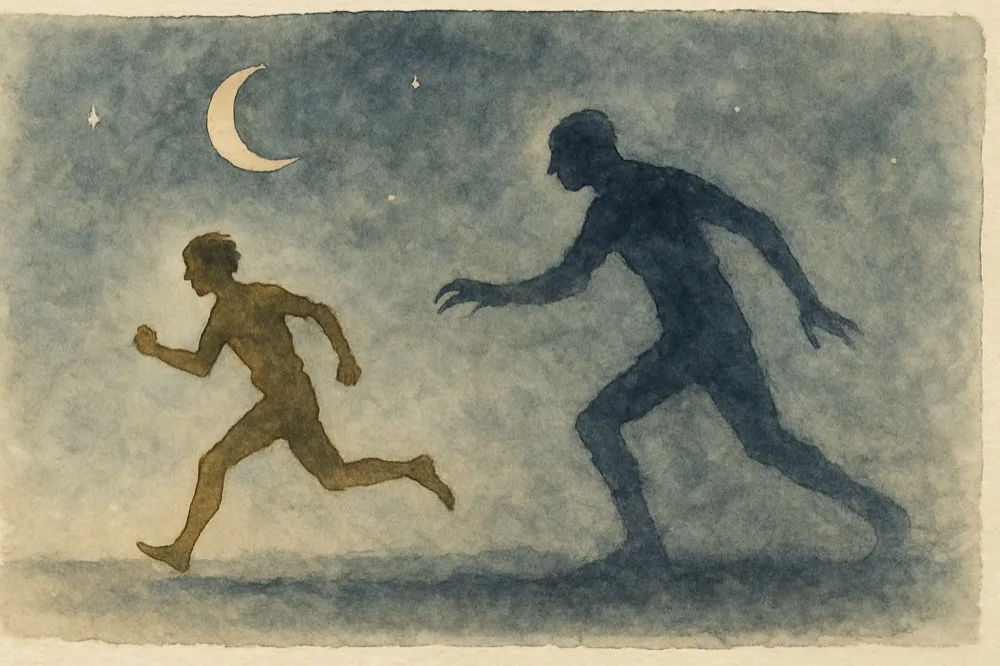
Few night experiences are as frightening as sleep paralysis. You are awake, or seem to be, but you cannot move or call out. The room looks real. Often there is a presence, a pressure on the chest, a figure at the edge of the bed. Then it passes, and you are left shaking and unsure what happened. This guide separates two things people often search together: sleep paralysis itself, and dreams in which you are paralysed. Both have something to say, and neither is a sign that something is wrong with your mind.
What is happening during sleep paralysis?
During dreaming sleep the body is held still, so that we do not act out our dreams. Sleep researchers describe sleep paralysis as a moment when awareness returns while that stillness remains. You are partly awake, but still partly dreaming, so dream imagery can appear in a room that looks exactly like your own. That is why the experience feels so real, and why it so often includes figures, voices or a weight on the chest. Episodes are commonly reported after short or broken sleep, and many people have at least one in their lives. A doctor can tell you more about your own experience; this guide is about what the images may mean.
Sleep paralysis in a dream within a dream
Many people describe waking from a dream, finding themselves paralysed in their bedroom, and then waking again, properly this time. The first waking was itself a dream. These false awakenings are a common companion to sleep paralysis, and they can loop several times before true waking. They are disorienting rather than dangerous. On the symbolic level, a dream within a dream can suggest a situation in which you think you have woken up to something, a problem, a relationship, a truth about yourself, but there is another layer still to come.
Dreams about being paralysed
Separate from sleep paralysis are dreams in which you cannot move, run, speak or scream, while the dream goes on around you. These are among the most common anxiety dreams. In the Jungian method they usually picture a waking situation in which you feel unable to act: a conflict you cannot speak up in, a decision you cannot make, a pressure you cannot escape. Ask where in your life you feel frozen. Notice what the dream wants you to do and cannot, because that is often what waking life is asking of you too.
The figure in the room
The most frightening feature of sleep paralysis is the presence: a dark shape, an old woman, a shadow by the door, something sitting on the chest. Jung would see such a figure as an image produced by the psyche, and so as a part of you. Very often it resembles what he called the shadow, the parts of ourselves we do not recognise as ours, made larger and darker by fear. This does not mean the figure is evil, or that you are. It means the psyche, caught between sleep and waking, has given a face to something heavy. The same figure appears in many dreams about being chased.
Spiritual and folk meanings of sleep paralysis
Human beings have described sleep paralysis for as long as records exist, and almost every culture has a name for its visitor. In Newfoundland it was the Old Hag. In Germanic and Norse folklore it was the mare, a spirit that sat on sleepers' chests and gave us the word nightmare. In Japan it is kanashibari, being bound as if by metal. In parts of the Islamic world it is linked to the jinn, and the Arabic word kabus names the pressing weight. Henry Fuseli's 1781 painting The Nightmare shows a demon crouched on a sleeping woman. Jung would call this amplification: the long human history of an image, which shows that what you met is not a private madness but one of the oldest experiences there is. The Jungian view is respectful of spiritual interpretations, and adds that whatever else the visitor may be, it is also an image to understand.
The woman at the foot of the bed
The dream below is invented for illustration. It shows the method, not anyone's real dream.
“I wake up and cannot move. There is an old woman sitting at the end of my bed, very still, looking at me. I try to scream and nothing comes out. Then I wake again, properly, and the room is empty. It is 4am. I lie there with the light on until it gets light.”
Symbols
Paralysis on waking. An old woman watching, silent and still. A false awakening before true waking.
The watching old woman is close to the Old Hag of folklore and to the crone figure in fairy tales, often feared, sometimes wise. Being watched and unable to speak is a picture of being judged without the power to answer.
Analysis
The dreamer, a nurse working nights, says the episodes started after she began a series of long shifts. Asked about the old woman, she thinks of her grandmother, who was strict and silent, and of a patient she lost the week before.
Her waking attitude is that she is coping. The figure compensates by appearing exactly when her guard is down: still, watching, and silent, like a judgment she has not voiced against herself.
One interpretation among several: the old woman carries the grief and self-reproach that her work leaves no room for. She sits at the foot of the bed because there is nowhere else for her.
Ritual
In daylight, picture the old woman and ask her one question: what do you want me to see? Write down the first answer without judging it. Then speak to your manager or GP about your sleep and shifts.
What to do with the experience
Write down what you saw, heard and felt as soon as you are calm. Over several episodes, patterns may appear: the same figure, the same room, the same sensation. Ask what the figure resembles in waking life, and what pressure it might picture. Some people find it helps, if paralysis comes again, to focus on small movements such as a finger or the eyes, and to remind themselves that it will pass. During the day, the practice of active imagination, returning to the image calmly and letting it speak, can take away some of its terror. If episodes keep returning, our guide to recurring nightmares covers related ground. More on frightening dreams in general is in our guide to nightmares.
When to talk to someone
Talk to your GP if sleep paralysis happens often, if it leaves you afraid to go to sleep, if you are very sleepy during the day, or if you fall asleep suddenly at unexpected times. Your GP can refer you to a sleep clinic if needed. The same applies if the experience is tied to distress, or to memories of something traumatic. Reflection on the images is not a substitute for that advice.
Common questions
What does it mean to dream of sleep paralysis?
Sleep paralysis is a moment when the mind wakes while the body's dream stillness remains, so dream images can appear in a room that looks real. In the Jungian method the figures and feelings in it can be understood as images of what is pressing on you.
What is sleep paralysis in a dream within a dream?
It is when you seem to wake, find yourself paralysed, and then wake again for real. The first waking was a false awakening, which commonly accompanies sleep paralysis. Symbolically it can suggest there is another layer still to wake up to.
What does paralysis in a dream mean?
Dreams in which you cannot move, run or scream usually picture a waking situation in which you feel unable to act. Ask where in your life you feel frozen, and what the dream wants you to do and cannot.
What is the spiritual meaning of sleep paralysis?
Almost every culture has described a night visitor, from the Old Hag of Newfoundland to the mare that gave us the word nightmare. The Jungian view respects these interpretations and adds that the visitor is also an image of something in you.
Written by the Coniunctio editorial team and reviewed against our editorial standards. Coniunctio offers reflection, not diagnosis or prediction. If a dream is tied to distress, please speak to a professional.
Related guides
What is Coniunctio?
A dream can stay with you all day and still make no sense. Coniunctio analyses it in Jung's method, symbol by symbol, so you can see what it is working on and what to do with it.
- A Jungian analysis of your dream, symbol by symbol
- A ritual to work with it: three offered, you choose one
- Follow-up questions and notes on every analysis
- A dream archive that grows as you feed it