What it means when you dream you can fly, read the Jungian way
Last updated: October 2026
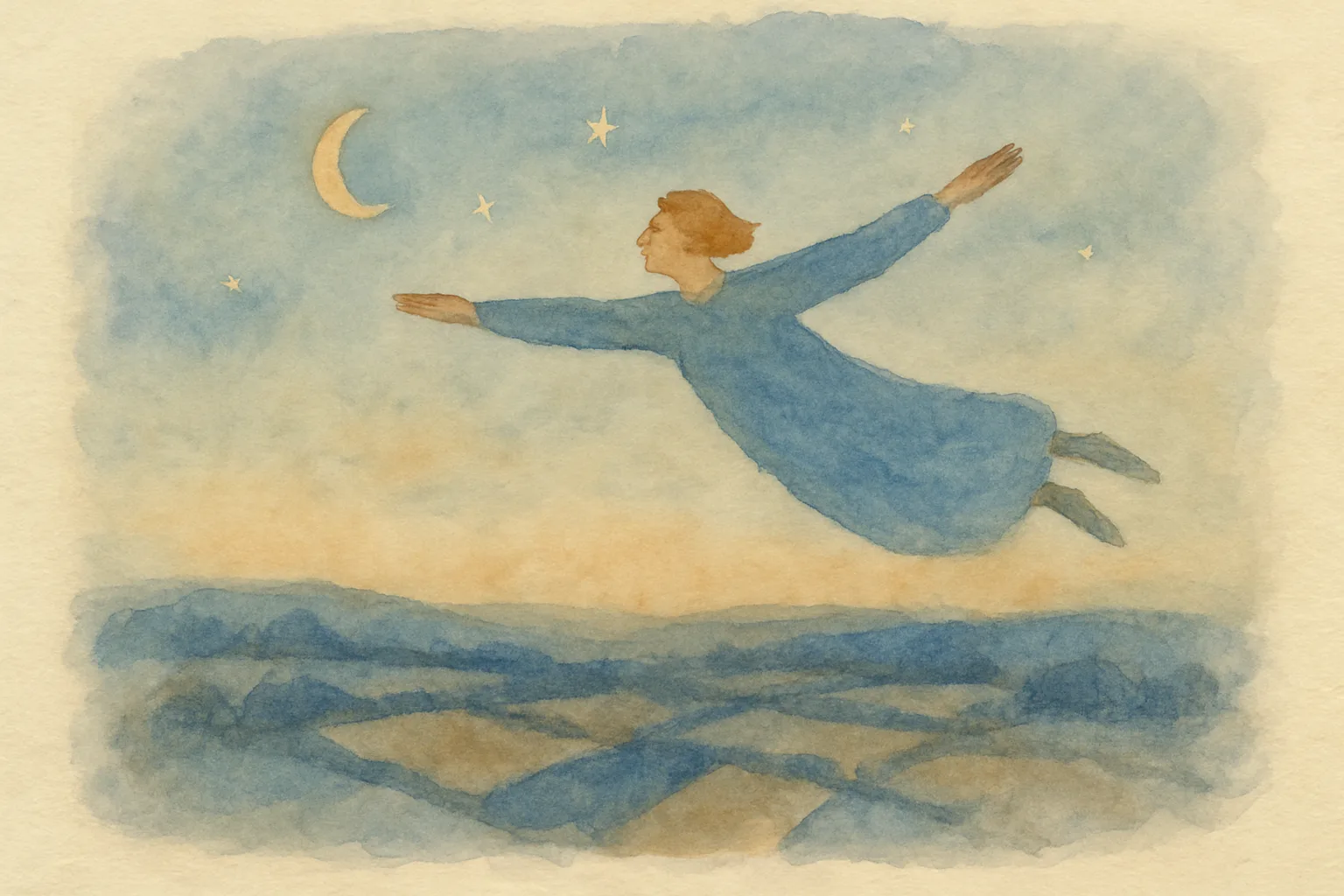
A dream of flying most often pictures a relationship to height: freedom from a weight, a wider view, or a wish to be lifted clear of something on the ground. In the Jungian method it is neither good nor bad by itself. The reading turns on how the flight felt, how much effort it took and what you were leaving below.
Flying is the dream people most enjoy and most want explained. The pleasure of it can make it seem obviously positive, a sign that things are going well. Sometimes it is exactly that. But a Jungian reading does not stop at the good feeling. It asks what the flight is doing, because the same image can mean release from a real burden or flight from something that needs facing. The sections below take the facets of flight one at a time. None of them is the answer to your dream. Each is a question worth putting to it.
Is it a good or bad dream to dream about flying?
Neither, as a rule, and the question is the right place to start because most people wake from a flying dream with a verdict already forming. A flying dream is not a sign of luck. It is a picture of how you stand, at this moment, in relation to the ground of your life: its weight, its obligations, its limits. The useful distinction is not good against bad but ease against strain, and toward against away. Those two pairs between them account for most of what a flying dream can mean.
Flying with ease: freedom and release
Gliding, banking, entirely at home in the air: this is the flight people remember with longing. Read plainly, it often reflects a real freedom or a competence that has come into its own. Something that used to be heavy has lightened, a decision has been made, or a capacity you doubted has proved itself. The dream shows you moving without the usual weight, and it is fair to let that stand. The question to put to it is simple: where in waking life do you feel, or want to feel, that same lightness?
Struggling to stay airborne
The opposite dream is just as common. You flap and pump to gain height, sink toward rooftops and power lines, and sense that a moment's inattention will bring you down. One reading is that you are holding a freedom or an ambition that is real but costly to sustain: living above your natural ground and feeling what that costs. The struggle is not failure. It is the dream registering effort, and asking whether the height is worth the strain or whether some of the weight pulling at you wants attention instead.
Flying too high: inflation and Icarus
Jung used the word inflation for a particular danger of the psyche: an over-identification with a role, a gift or an idea of one's own importance that lifts the ego above ordinary human life. A dream of flying higher than feels safe, or straining toward the sun, can carry exactly this. The Greek myth of Icarus is the old version of the image: wings of wax and feathers that fail when he climbs too close to the sun. This is not a prophecy of a fall. It may be the psyche marking a stance that has drifted too far from the ground.
The eternal youth: flying and the provisional life
Marie-Louise von Franz, one of Jung's closest collaborators, wrote at length about the puer aeternus, the eternal youth: a pattern in which life is lived provisionally, kept open, never quite committed to, because commitment feels like being grounded. She noticed how often flight and aviation appear in the dreams and lives of people caught in this pattern. A recurring flying dream that feels like escape from every tie may point here. It is a reading to hold gently, since the same pattern also carries real gifts: openness, imagination, an unwillingness to settle for too little.
Flying away: rising above or running from
The same flight can mean release or avoidance, and only context tells which. Flying as freedom lifts you toward something: a wider view, a lightness earned. Flying as escape lifts you away from something: a conflict, a grief or a decision on the ground that you would rather not meet. Some dreamers take off in the middle of a chase, and the flight is plainly a way out. The dream does not judge the escape. It shows it, and asks what would be waiting if you came back down and stood still.
What does it mean if you dream about flying without wings?
Most dream flight happens without wings. People swim through the air, rise by willing it, or simply know how, as if they had always known. Because no mechanism is involved, the image is less about how you fly than about the capacity itself: moving above the ordinary pull of things. Dreams with wings, of a bird, an angel or an aeroplane, add a carrier, and that carrier deserves its own association. Without one, the question returns to you: what lifted you, and did it feel like your own power or something given?
The view from above: flying over a landscape
Many flying dreams are less about motion than about seeing. You look down on a town, a coastline or a house you know, and everything appears small and ordered. Height gives perspective, and the dream may be offering an overview of a situation you are too close to in waking life. Note what you looked at and how it looked. Familiar places seen from above can carry tenderness or detachment, and that difference matters. Distance can clarify, and it can also be a way of not feeling.
Flying with fear, or flying that turns into a fall
Not every flight is a pleasure. Some dreamers fly while terrified of the height, or lose the ability halfway and begin to drop. Here the flying dream meets its neighbour, the falling dream, and the two are worth reading together. A flight that fails can attach to confidence that has outrun its footing, or to a fear that a good period cannot last. The feeling at the moment the flight changes is usually the most precise information the dream offers, so it is worth recording before anything else.
Lucid flying: knowing you are dreaming
Flying is one of the things people most often do once they realise they are dreaming. Lucid dreams, in which the dreamer knows the dream for what it is, have been studied in sleep laboratories, and many lucid dreamers describe choosing to take off. That experience of agency inside the dream is vivid and worth recording. A Jungian reading still asks of it what it asks of any flight. Where did you choose to go, what did you leave below, and what would it mean to bring that sense of choice into waking life?
Is it rare to dream about flying?
No. Flying is one of the recognised typical dreams. In questionnaire studies a large share of people, around half in some samples, say they have dreamed of flying at least once, though fewer report it than report falling or being chased. For most people it is less frequent than those themes, which may be part of why it is remembered so vividly. Frequency tells you little about meaning. A single flying dream in a year of falling dreams, though, may mark a change in your waking stance.
What's the rarest dream to have?
There is no reliable answer to this, and it is better to say so plainly. Dream research measures which themes are common, mostly through surveys of typical dreams. No study ranks dreams by rarity, and the lists online that name a rarest dream are not drawn from research. The question is still a good one to bring to your own dreams. An image that appears once in years of dream records, a new figure or a place you have never dreamed before, can mark something new arriving in the psyche.
Flight, birds and the spirit
Across traditions, flight has stood for the spirit freed from the body: the bird as the soul, the angel as messenger, the ascent as a picture of transcendence. Jung read birds in dreams as frequent images of spirit and thought, of what moves above the earth. The Jungian view does not dismiss those meanings. It treats them as the image's long history. The meaning for you is narrower: whether your flight carried something like aspiration or insight, and whether it brought you back to the ground with something useful.
A worked dream: flying over the old school
The dream below is invented for illustration. It shows the method, not anyone's real dream.
"I am standing in the playground of my old school and realise I can fly if I lean forward. I rise easily over the roofs and the town looks tiny and beautiful. Then I see my sister waving from the school gate, and I try to come down, but I can't. I keep drifting higher, and the only way to stay level is to stop looking at her."
The image
Effortless flight from a childhood place. A beautiful view. A sister calling from the gate, and a flight that will only stay steady if the dreamer looks away.
Personal association
The dreamer recently moved abroad for work and loves her new life. Her sister is caring for their father, who is unwell. She says the move felt "like finally breathing."
Amplification
Flight is the old image of release from the earth and its weight. The school is the place where one first learns the rules of belonging. The ascent that cannot come down echoes the provisional life, a height that has stopped being chosen.
Compensation
Her waking attitude is relief and gratitude for the new freedom. The dream sets beside it a cost she has not looked at: staying aloft requires not seeing her sister. It compensates for the pure lightness by showing what the lightness rests on.
Synthesis
One reading among several: the freedom is real and does not need to be given up, but it has begun to depend on not looking at a family weight carried by someone else. The dream does not tell her to move home. It asks whether she can look down and still fly.
A small ritual
For five minutes, write what she would say to her sister at the gate if she could land for an hour. Then send one line of it, in her own words.
Why your flight means something different from anyone else's
The facets above are amplification: the long record of what flying has meant to people. They are not your meaning. The same easy flight reads one way for someone recovering from a heavy year and another for someone avoiding a decision, and only your associations can tell them apart. That is the difference between a symbol and a dictionary entry, and it is why Jungian symbols are personal before they are universal. For the full method behind this reading, see Jungian dream analysis, and for the step-by-step, how to interpret your dream.
Your flight, not the flight.
Read last night's dream the way an analyst would: every image named, your associations gathered, one synthesis and a small ritual to carry it into the day. About ninety seconds.
Bring your own dreamNo account needed, and the first reading is free.
Common questions
Is it rare to dream about flying?
No. In questionnaire studies of typical dreams, a large share of people say they have dreamed of flying at least once, though fewer than report falling or being chased. It is less frequent than those themes for most people, which may be why it feels memorable. Frequency says nothing about meaning; the quality of the flight does.
What does it mean if you dream about flying without wings?
Most dream flight happens without wings, by swimming through air, rising on will alone or simply knowing how. That makes the image less about a mechanism and more about a capacity: moving above the ordinary pull of things. The useful questions are how easy it felt, what lifted you, and whether you were rising toward something or away.
What's the rarest dream to have?
There is no reliable answer. Dream research measures which themes are common, through surveys of typical dreams, but no study ranks dreams by rarity, and the lists that claim to are not research. A rare image in your own dream record is worth attention for a different reason: it may mark something new arriving in the psyche.
Is it a good or bad dream to dream about flying?
Neither, as a rule. Flying dreams are often felt as freeing, and that feeling matters, but in the Jungian method the reading turns on the quality of the flight. Easy flight, strained flight and flight that climbs too high point in different directions. Whether it reads as release or as escape depends on your waking situation.