What do recurring dreams about the same person mean?
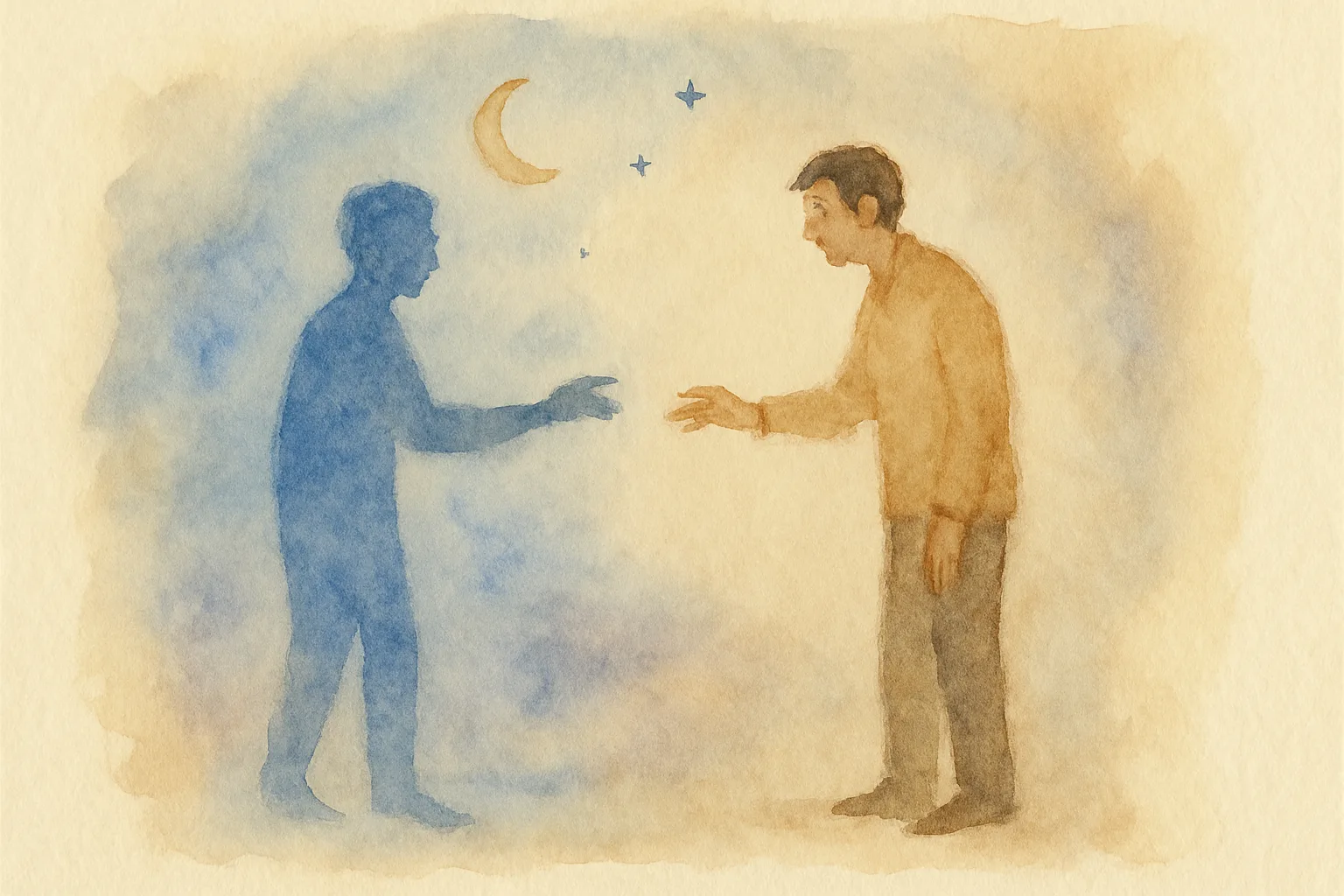
Sometimes it is an ex, or a parent. Often it is someone stranger: a schoolfriend you have not seen in twenty years, a colleague you hardly speak to, a person with no name you keep meeting in different dreams. The worry is usually the same. Why this person, and does it mean something about them?
Does it mean they are thinking about me?
This is the question most people wake with, and the answer is no. A dream is made by your psyche from your memories and feelings. It has no access to anyone else's mind. What it can show, with real precision, is what that person has come to mean for you.
That meaning can be surprising. A figure who seems trivial in waking life may carry something important in the dream: a confidence you lack, a way of living you set aside, a hurt you have not finished with.
The person as a part of you
Jung distinguished between taking a dream figure objectively, as the actual person, and subjectively, as a part of the dreamer. With people you are close to, both views can apply. With people who recur but barely feature in your life, the subjective view is usually the stronger one.
Try describing the person in three adjectives, as if to a stranger. Then ask whether those adjectives name something you are short of, or something in yourself you dislike. Jung called the disowned side the shadow, and recurring figures of the same sex as the dreamer often carry it.
A stranger who keeps appearing
Some recurring figures have no waking original. They have a face you know only from dreams, or no face at all. Jung understood such figures as personifications from deeper in the psyche: an inner guide, a shadow figure, or the contrasexual figure he called the anima or animus.
Notice what the stranger does across dreams. A figure who keeps helping you, keeps watching you, or keeps leaving just as you approach is telling a story over time. The arc matters more than any one meeting.
Jung also observed that such figures can be ahead of the dreamer, carrying an attitude the dreamer has not yet reached. A recurring stranger who is calmer, braver or kinder than you are may be showing a direction of growth rather than a threat.
Why do I have the same recurring dream?
When the person and the plot repeat together, the dream is circling something. Jung's principle was that what is not made conscious tends to return. A recurring dream is less a fixed message than an unanswered one. Our hub on recurring dreams covers this in more depth.
If the person in question is a former partner, our guide on dreams about your ex addresses that version directly.
Details that change the meaning
How you feel when you see them is the first detail to note. Relief, dread, longing and irritation point in different directions. What they are doing is the second. Someone who keeps arriving uninvited is different from someone you keep looking for.
Note too whether the person has changed. A figure who was younger, or ill, or angry in earlier dreams and is now different may be marking a change in how you hold what they represent.
Where you meet them is a third clue. The same person in your childhood kitchen and in an office you have never seen is carrying a different emphasis each time, and the settings, taken together, often show which part of your life the figure belongs to.
The schoolfriend at the station
The dream below is invented for illustration. It shows the method, not anyone's real dream.
“Clare from school is at a train station again. She is always about to get on a train and waves for me to come. I never have my bag. This time I have it, but the train leaves as I reach her. She doesn't look upset. I wake up annoyed with myself.”
Symbols
A friend from adolescence, not seen in years. A station, a place of departures. An invitation repeated. A bag that, for once, is ready.
Stations and trains are images of transition and timing. A companion who beckons onward is an old figure of the guide.
Analysis
Asked about Clare, the dreamer says she was the bold one, who left for a gap year when he stayed at home. He has been offered a posting abroad and has not decided.
His conscious attitude is caution: he is weighing practicalities. The dream sets beside it a figure who carries the boldness he admired and did not claim. This time he is packed, which suggests readiness is closer than he thinks.
One interpretation among several: Clare returns not as Clare but as his own capacity to go. Her calm at the missed train suggests the opportunity is not lost for good.
Ritual
Write down the one thing Clare would say about the posting. Then write what you would say back.
What to do with a recurring figure
Write a short letter to them that you will not send. Ask what they want, and let yourself write the answer as they might give it. This is a gentle form of active imagination. It treats the figure as a part of you with something to say.
If the person is someone you have lost, the questions are different and deserve more care. Our hub on dreams about people who have died is written for that.
Common questions
What do recurring dreams about the same person mean?
Usually that the person carries a quality, feeling or unresolved question of your own. The figure returns until that is recognised. Your associations to them are the key.
Does dreaming about someone repeatedly mean they are thinking of me?
No. A dream is built from your own memories and feelings and cannot report another person's thoughts. It shows what they mean to you.
Why do I keep dreaming about someone I barely know?
A minor acquaintance can carry a major quality for you. Describe them in a few words and ask whether that describes something you lack or have pushed away.
Why do I have the same recurring dream?
Recurring dreams return to something that has not yet been made conscious. Writing down when the dream comes back, and what changes in it, often shows what it is circling.
Written by the Coniunctio editorial team and reviewed against our editorial standards. Coniunctio offers reflection, not diagnosis or prediction. If a dream is tied to distress, please speak to a professional.
Related guides
What is Coniunctio?
A dream can stay with you all day and still make no sense. Coniunctio analyses it in Jung's method, symbol by symbol, so you can see what it is working on and what to do with it.
- A Jungian analysis of your dream, symbol by symbol
- A ritual to work with it: three offered, you choose one
- Follow-up questions and notes on every analysis
- A dream archive that grows as you feed it
“The dream is a little hidden door in the innermost and most secret recesses of the soul, opening into that cosmic night which was psyche long before there was any ego-consciousness.”